Building a Men's Skincare Brand: The Three-Category Core
A men's care range stands on three categories before it stands on anything else: facial cleansing, face creams and face essences. The client's own men's care page calls those three the troika of the category, with beard oil as a natural adjacency. The same published pages put the capacity behind any such line at 160M units a year, 200,000 a day and about 5,714 units per line per day.
Key takeaways
- Cleanser, cream and essence are the published core three; beard care sits beside them as an extra.
- Published capacity is 160M units a year, 200,000 a day across 35 lines, about 5,714 units per line per day.
- Typical order minimums run 1,000–5,000 units per product, with a 500-unit startup entry.
- OEM beard oil is offered with bottle and label customisation, so the adjacency can match the core.
Three categories form the core
A men's range does not need twenty stock-keeping units to look complete. The client's page names facial cleansing, face creams and face essences as the troika, the three products that carry the daily routine from wash to finish. Everything else is an addition. Starting with the core three gives a shelf a beginning, a middle and an end.
| Category | Role in the range | First-run note |
|---|---|---|
| Face cleanser | Opens the routine and sets the first impression | Type and texture chosen separately |
| Face cream | Carries the main functional claim | Texture tuned for a lighter feel |
| Face essence | Adds a fast step between wash and cream | Pairs with the cream instead of repeating it |
| Beard oil | Widens the shelf for bearded buyers | Offered with bottle and label customisation |
Read the three as a sequence rather than a list. Each product answers the one before it, and together they tell a buyer that the range was designed rather than assembled. That sequencing is also what makes a range easier to market, because the routine is the message.
Why the core beats a single hero product
A new men's skincare brand that opens with one hero product asks a buyer to win on one claim against a crowded shelf. A three-category core asks the buyer to adopt a routine, which is a larger decision but a stickier one. Once a wash, a cream and an essence are on the shelf together, replacing any one of them means breaking the set.
There is a production reason as well. A core built from three related products lets a brand reuse packaging families, share shipping cases and hold one visual language. The catalogue stays small while the range still looks full, which matters most in the first year when cash and shelf space are both tight.
Beard care as the adjacency that widens the shelf
Beard oil is the cleanest addition to a men's core because it reaches buyers the other three do not. The client's men's care category lists beard oil first, and the same site notes that OEM beard oil comes with bottle and label customisation. That means the extra product can carry the same identity as the core without a separate design round.
Treat the adjacency as a second wave. Launch the core three, learn what buyers ask for, then add beard care once the brand has a face. Adding it too early spreads a small budget across four products before any of them has proved it can sell.
What the 2025 trend reading says about buyers
The site's reading of 2025 China men's skincare trends points to four movements: young groups dominate, mature men's demand differentiates, functional products expand, and scenario innovation grows. Read together, those four say the same thing. A single generic men's cream no longer covers the market that a three-category core can.
Younger buyers reward a clear routine and quick texture. Older buyers reward specific functions and less fragrance. Scenario thinking, such as a post-shave step or a travel set, is what turns the core into something a buyer recognises as made for them. The categories stay the same; the story around them moves.
Capacity behind a men's care line
Take the published capacity block and reconcile it with the chart. The site lists 160M units a year, a daily capacity of 200,000 units and 35 automated production lines. Dividing the daily figure by the lines gives 200,000 ÷ 35 ≈ 5,714 units per line per day, which is the third bar. Now size a first run for the core three: at 3,000 units per product the order is 3 × 3,000 = 9,000 units, and 9,000 ÷ 5,714 ≈ 1.6 line-days, or about two days of one line's published output. At 10,000 units per product the order is 3 × 10,000 = 30,000 units, and 30,000 ÷ 5,714 ≈ 5.3 line-days.
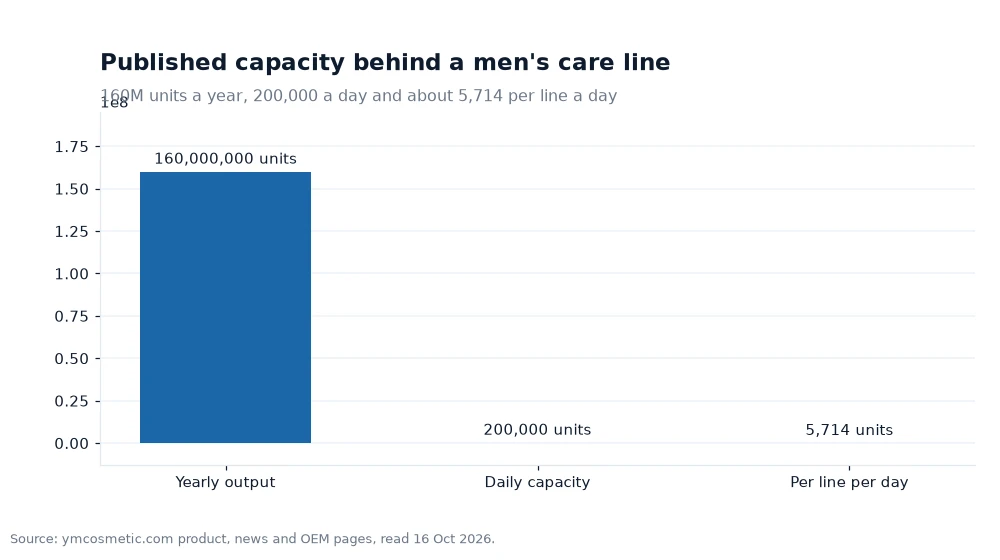
The two numbers to keep in view are 200,000 and about 5,714. The first is the plant-wide daily ceiling and tells a brand how much room exists in total. The second is what one line delivers in a day and tells a brand how small a run can be without waiting for a whole line to free up. Between them, a three-product first order is a fraction of a single day across the plant.
Textures and claims that carry a functional story
A men's core lives or dies on texture. The cleanser should rinse clean without leaving a film, the cream should absorb before a shirt collar can catch it, and the essence should feel lighter than the cream rather than like a second cream. Those three texture targets are separate briefs even though they share one design language.
On the claim side, a functional product still has to respect the testing calendar. Stability and compatibility reports take 3–6 months, and any sensitive-skin wording waits on patch test results. The client states that the platform holds over 10,000 mature formulas and can fine-tune fragrance, texture and skin feel, which is where the lighter men's feel is usually settled.
Building the brief, order by order
Write one brief per product and one brief for the range. The range brief fixes the shared identity; the product briefs fix texture, claim and pack. That structure keeps the core coherent while still letting the essence be lighter than the cream and the cleanser be chosen by type and texture rather than by colour alone.
Then set the order size. Typical minimums run 1,000–5,000 units per product, and the client notes that some manufacturers offer a lower entry of 500 units for startups. A first range of three products at the lower end is a realistic opening order, and it still fits inside the published capacity with room to repeat.
Frequently asked questions
Which three categories should a men's range start with?
The client's men's care page names facial cleansing, face creams and face essences as the troika that forms the core of the category.
Where does beard care fit?
Beard care works as an adjacency after the core three, and the site offers OEM beard oil with bottle and label customisation so it can match the range.
What capacity sits behind a men's care line?
The published figures are 160M units a year, a daily capacity of 200,000 units across 35 lines, and about 5,714 units per line per day.
Build the range, not the one-off
Start with the core three, fix the shared identity, and add beard care once the range has a face. Yunmei runs OEM/ODM men's care projects from a single brief and publishes the capacity and minimums a new brand needs to size a first order. The one-stop OEM and ODM service page shows how the categories sit inside one production plan, and the men's face cleanser page details the first category in the core.
Quoted ranges and processing figures were collected from the company's own pages on 16 Oct 2026.[1]