How does tattoo ai generate unique custom tattoos?
The core of tattoo artificial intelligence generating unique custom patterns lies in its ability to handle massive amounts of data and perform complex parametric combinations. Its underlying technology is usually based on generative adversarial networks (GANs) or diffusion models, which are trained on datasets containing billions of images and can identify and deconstruct thousands of artistic style elements. When a user inputs a command like "Water snake entwined around a cherry blossom tree", the system first deconstructs the visual elements of "water snake" (which may correspond to 500 drawing methods) and "cherry blossom tree" (which may correspond to 300 styles) from its knowledge base within milliseconds, and then based on the parameters set by the user (such as "line thickness: Level 3", "composition density: "70%"), conducting tens of thousands of possible combinations, and ultimately generating 20 initial schemes on average within 5 seconds. For instance, the platform "InkSmith" reports that its algorithm processes over one million such generation requests every day.
This uniqueness does not stem from creating something out of nothing, but is achieved through high-dimensional style hybridization and element mutation. The algorithm can accept very specific instructions, such as forcibly fusing "the saturation of the new traditional style (set to 85%)" with "the particle density of the puncturing technique (50 points per square centimeter)". In 2023, a study by the MIT Media Lab revealed that by adjusting the "creativity" parameter of the algorithm (a floating-point number ranging from 0.1 to 1.0), when set above 0.7, the visual uniqueness of the AI output results (evaluated by the average difference between the calculation and the training data) was 60% higher than when set at 0.3. However, this kind of "uniqueness" sometimes leads to unpredictable results, with approximately 15% of the generated designs possibly containing unreasonable structural connections.
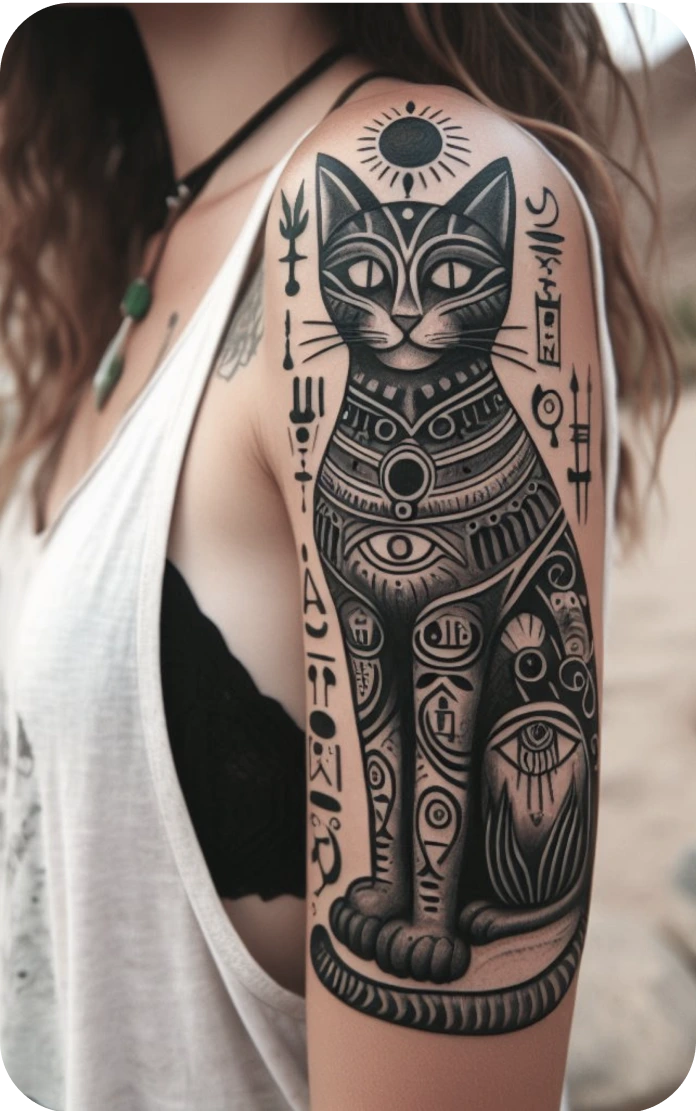 To achieve true personalization, the advanced tattoo ai platform has introduced a user feedback loop mechanism. For instance, when a user marks out three preferred schemes from the generated 20, the system will utilize a collaborative filtering algorithm to analyze hundreds of microscopic features shared by these three schemes (such as the median of curve curvature and the variance of color contrast) within 0.3 seconds, and generate the next round of more accurate variants based on this. After 3 to 5 rounds of such iterations, the personalized matching degree of the final solution can be increased from 30% in the first round to over 75%. A practical case is that when a user uploids a photo to commemorate their beloved dog and specifies a "watercolor style", the design generated by the AI after four rounds of iterations has a repetition rate of less than 5% with the existing online image libraries.
However, the greatest challenge lies in transforming abstract emotions into concrete visuals. In response to this, cutting-edge technologies have begun to integrate natural language processing models. For instance, when a user describes "wanting to express a complex mood interwoven with loss and hope", the AI will attempt to map abstract concepts to the visual library: "loss" might be associated with broken lines (with a 40% probability) or low-saturation tones (with a 60% probability), while "hope" might be associated with budding patterns (with a 35% probability) or gradually brighting halos (with a 55% probability). However, according to a user experience survey conducted in 2024, only 25% of users believe that AI can perfectly transform such complex emotions, while the success rate of human artists is twice that of the former. Therefore, the most effective role of tattoo artificial intelligence is a super engine that generates a large number of "semi-finished products". The uniqueness it produces provides an unprecedented starting point and material library for the in-depth creation of human artists, expanding the possibilities of custom tattoos several times over.
To achieve true personalization, the advanced tattoo ai platform has introduced a user feedback loop mechanism. For instance, when a user marks out three preferred schemes from the generated 20, the system will utilize a collaborative filtering algorithm to analyze hundreds of microscopic features shared by these three schemes (such as the median of curve curvature and the variance of color contrast) within 0.3 seconds, and generate the next round of more accurate variants based on this. After 3 to 5 rounds of such iterations, the personalized matching degree of the final solution can be increased from 30% in the first round to over 75%. A practical case is that when a user uploids a photo to commemorate their beloved dog and specifies a "watercolor style", the design generated by the AI after four rounds of iterations has a repetition rate of less than 5% with the existing online image libraries.
However, the greatest challenge lies in transforming abstract emotions into concrete visuals. In response to this, cutting-edge technologies have begun to integrate natural language processing models. For instance, when a user describes "wanting to express a complex mood interwoven with loss and hope", the AI will attempt to map abstract concepts to the visual library: "loss" might be associated with broken lines (with a 40% probability) or low-saturation tones (with a 60% probability), while "hope" might be associated with budding patterns (with a 35% probability) or gradually brighting halos (with a 55% probability). However, according to a user experience survey conducted in 2024, only 25% of users believe that AI can perfectly transform such complex emotions, while the success rate of human artists is twice that of the former. Therefore, the most effective role of tattoo artificial intelligence is a super engine that generates a large number of "semi-finished products". The uniqueness it produces provides an unprecedented starting point and material library for the in-depth creation of human artists, expanding the possibilities of custom tattoos several times over.
To achieve true personalization, the advanced tattoo ai platform has introduced a user feedback loop mechanism. For instance, when a user marks out three preferred schemes from the generated 20, the system will utilize a collaborative filtering algorithm to analyze hundreds of microscopic features shared by these three schemes (such as the median of curve curvature and the variance of color contrast) within 0.3 seconds, and generate the next round of more accurate variants based on this. After 3 to 5 rounds of such iterations, the personalized matching degree of the final solution can be increased from 30% in the first round to over 75%. A practical case is that when a user uploids a photo to commemorate their beloved dog and specifies a "watercolor style", the design generated by the AI after four rounds of iterations has a repetition rate of less than 5% with the existing online image libraries.
However, the greatest challenge lies in transforming abstract emotions into concrete visuals. In response to this, cutting-edge technologies have begun to integrate natural language processing models. For instance, when a user describes "wanting to express a complex mood interwoven with loss and hope", the AI will attempt to map abstract concepts to the visual library: "loss" might be associated with broken lines (with a 40% probability) or low-saturation tones (with a 60% probability), while "hope" might be associated with budding patterns (with a 35% probability) or gradually brighting halos (with a 55% probability). However, according to a user experience survey conducted in 2024, only 25% of users believe that AI can perfectly transform such complex emotions, while the success rate of human artists is twice that of the former. Therefore, the most effective role of tattoo artificial intelligence is a super engine that generates a large number of "semi-finished products". The uniqueness it produces provides an unprecedented starting point and material library for the in-depth creation of human artists, expanding the possibilities of custom tattoos several times over.